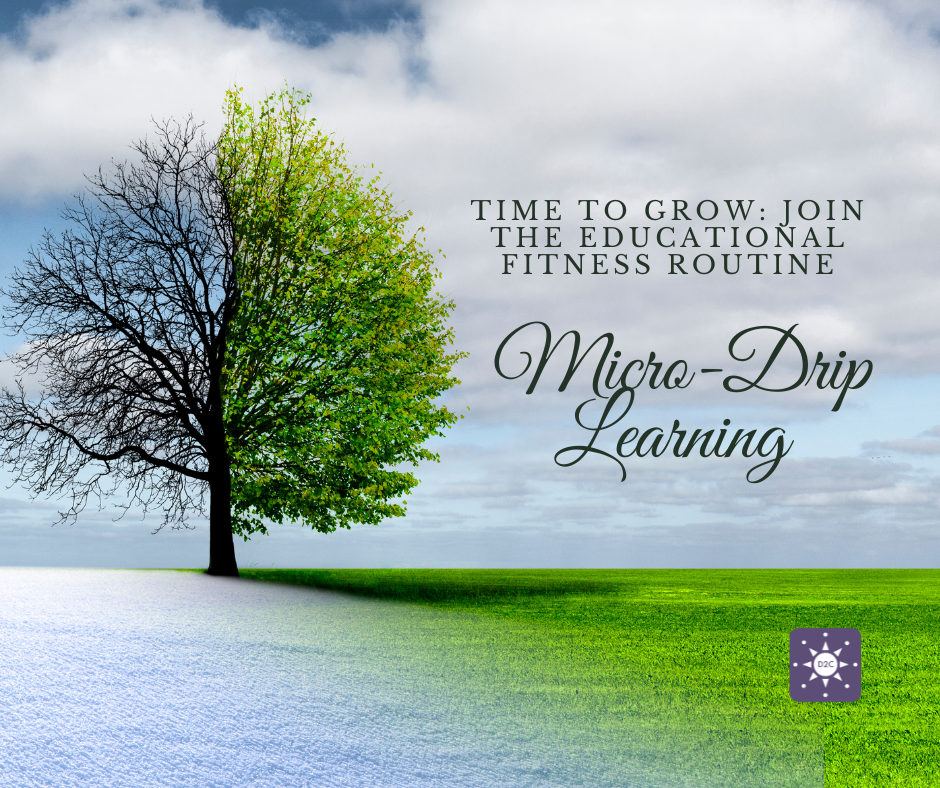
Why Micro-Drip Learning is Your Brain’s Best Friend

Let’s face it, traditional learning can feel like force-feeding broccoli. We know it’s good for us, but that doesn’t make it any more enjoyable. Just like physical fitness, though, staying mentally sharp is crucial for a fulfilling life. But what if learning could be more like attending a fun, engaging fitness class for your brain?

Enter micro-drip learning! Imagine receiving bite-sized, 15-minute courses delivered daily throughout the year. Each “mental snack” tackles a different topic – business development, personal finance, ethics, artificial intelligence – the list goes on!

Here’s why Micro-Drip Learning is the secret weapon for your brainpower:

  • Small Doses, Big Results: Short, focused lessons make learning manageable and prevent information overload.You’ll retain more without feeling overwhelmed.
  • Variety is the Spice of Learning: Monthly themes keep things fresh and ensure you’re constantly acquiring new skills and knowledge.
  • Gamification Makes it Fun: Test your knowledge with quizzes and compete with friends and family. Learning becomes a friendly competition, boosting engagement and motivation.
  • No More Procrastination: Each lesson is available for only 3 days, keeping you on track and preventing that dreaded “I’ll do it later” syndrome.
  • Build a Well-Rounded Mind: Micro-drip learning equips you with the tools you need to excel in different areas of life, from communication and creativity to innovation and problem-solving.

Imagine the possibilities! Grandparents and kids alike could be discussing the latest advancements in AI or the importance of ethical decision-making. Learning becomes a conversation starter, fostering meaningful connections and ditching the negativity of “shockvertising.“

Ready to ditch the mental struggle and embrace a healthy learning lifestyle? Micro-drip learning offers a convenient, engaging way to become the best version of yourself. Sign up today and embark on a journey of continuous growth and self-discovery. Who knows, it might just be the first step towards achieving your dream life!

Click Here to receive updates about how Dream2Career is reimagining education so the system works for everyone.

Micro-Drip Learning Course Calendar

HIF Logic – The Six Sigma of Talent Development

The best way to create connections between workforce and education is to get the work-learn communities moving in the same direction. For this reason, Dream2Career developed HIF Logic. HIF stands for the Horizontal Industry Framework which crosses talent interests with all the job functions using only six areas. HIF Logic – is defined as the “Six-Sigma of Workforce Development”. HIF Logic provides a standardized workforce infrastructure that improves business productivity and decreases costs by increasing worker access to general education. This system is designed to improve employee motivation, minimize variation, increase quality, and improve efficiency.

The educational system, in all of its forms, is complicated and disjointed. For this reason we developed a standard communication / media delivery system that uses HIF Logic to simplify this complicated, but necessary, form of human development. The HIF Logic media schedule allows, learning providers, businesses, workforce groups, and government initiatives (HEMPEngine, MASH, DoD Skillbridge, etc) all to exist in the same communication system and thought stream, at predictable times, pertaining to educational initiatives. As communities and institutions,  “celebrate” learning events, programs, experiences using HIF Logic, it creates opportunities for close collaboration and innovation. Dream2Career recently developed a Work-Learn communications platform that is setup using HIF Logic to organize the educational system so that it works for everyone. Think how businesses plan communications around seasons and holidays. Imagine how much more effective workforce communications could be when streamlined using HIF Logic.

In addition to helping communities promote educational content, the HIF Logic framework was designed to help our student/workers to focus on personal and professional development, so that they could find passion and purpose through learning. Mental health is a huge issue for many and education, through shared learning experiences, helps to combat loneliness and depression and studies have shown education staves off dementia.

Dream2Career provides a 15-Min daily, shared learning diet through our Micro-Drip Learning platform, which consequently uses HIF Logic to provide useful educational content in a predictable, gamified way. This new learning style helps to stop the mindless media scroll and it provides career signals and confidence building mechanisms, so employees and career seekers can see hope for a better tomorrow.

If you are interested consuming your educational diet, click here to join the Micro-Drip. Our courses are developed by subject matter experts and have been used in over 70K businesses. Micro-Drip Learning helps users to understand strengths, weakness, and the strength of differences, so our users live the life they always wanted and they succeed in learning and in life.

About Dream2Career:

Dream2Career (D2C) uses education to attract, retain, and inspire the workforce of tomorrow.

Time to Grow: Start A New Educational Fitness Routine

Starting a new learning lifestyle is exciting! You’re energized by the potential for a mental healthier you. Unfortunately, staying motivated can be tough. Life gets busy, boredom hits, and the social media scroll suddenly seems very appealing.

Here’s where psychology comes in. By understanding how our brains work and what triggers behavior change, we can use these insights to our advantage.

Building on Classical Conditioning 

John B. Watson, a pioneer of behaviorism, famously demonstrated classical conditioning through his (now ethically questionable) experiment with Little Albert. While we wouldn’t want to use fear conditioning for education, the principle applies. Pair your learning with something you enjoy, like teaming up with a friend or playing music, SOFTLY, in the background. Over time, the positive association with learning can make you crave that feel-good state of mind.

Operant Conditioning: Rewarding Yourself 

B.F. Skinner, another behaviorist, championed operant conditioning, where behaviors are reinforced or punished by their consequences. This is all about rewarding yourself for sticking to your goals. After a microcourse, treat yourself to a trip to store or cappuccino. Completing a week of Micro-Drip Learning? Celebrate with a relaxing bath or a tickets to your favorite performer.

The Power of Goals 

Setting clear, SMART goals (Specific, Measurable, Achievable, Relevant, and Time-bound) is crucial for success according to Edwin Locke and Gary Latham’s goal-setting theory. Instead of a vague desire to “start learning,” aim to “connect the learning to ways to upskill into your dream career” or “to find your passion so you can live your best life.” Track your progress and celebrate milestones to stay motivated.

Social Influence: Partner Up or Find a Support Group

We are social creatures, heavily influenced by those around us. Find a learning buddy or join the Micro-Drip Learning classes. Social support and a little friendly competition can go a long way in keeping you accountable and keep your interest level high.

Beyond Behaviorism: The Role of Mindset

While behaviorism provides powerful tools, psychology is multifaceted. Carol Dweck’s work on mindsets highlights the importance of believing in your ability to change. Instead of viewing setbacks as failures, view them as actual learning experiences. This growth mindset fosters resilience and keeps you going when things get tough.

Remember, creating sustainable change takes time and effort. By using these psychological principles, you can develop a routine that feels good and fits seamlessly into your life. So, put on your glasses, and get ready to achieve your goals in learning and in life!

References

  • Baron, R. A., & Branscombe, N. R. (2016). Social Psychology (13th ed.). Pearson.
  • Dweck, C. S. (2006). Mindset: The new psychology of success. Random House.
  • Locke, E. A., & Latham, G. P. (2002). Building a critical mass of evidence to make contingent reward effective for motivating employee performance. Organizational Dynamics, 31(2), 38-58.
  • Rosenthal, M. (2004). Little Albert and the beginnings of behaviorism. American Psychologist, 59(3), 205.
  • Schultz, D. P., & Schultz, S. E. (2016). A theory of controlled and automatic mental processes applied to learning.Psychological Bulletin, 93(1), 139.

inspiration- Education creates bliss

From Ignorance to Bliss: The (Honest) Struggle of a Healthy Mind

Let’s be real: the image of happiness from a life of dedication often glosses over the messy reality of getting started. Education, the holy grail of mental fitness transformations, can feel as intimidating as scaling Mount Everest in your pajamas.

Here’s the truth: Getting Started is HARD. Here’s why:

  1. The Intimidation Factor: Libraries and schools are filled with seemingly effortless regulars. You might feel like a lost puppy wandering into a dog show. Don’t worry, everyone started somewhere, even Albert Einstein; who, by the way, was dyslexic.
  2. Learning the Lingo: Visionary, Maven, Processor, Protector, Specialists, Naturalist –– a whole new vocabulary bombards you. It’s okay to ask for help! Teachers are there to guide you, not judge you.
  3. The Soreness Struggle: Mental fatigue after you fail a quiz isn’t a badge of honor, it’s a reminder that your mind is protesting this new activity. Start slow, listen to your body, and embrace the fact that frustration with learning is temporary (but oh-so-real).
  4. Media Dilemma: Forget quick fixes like listening to news and social media. Creating a healthy education diet takes courage and effort. Saying goodbye to the scroll and hello to Micro-Dripping can feel like a major life shift.
  5. Motivation Meltdown: Life gets busy. Work, family, social commitments –– suddenly that 15-minute micro-course seems impossible. Don’t beat yourself up. Focus on consistency, not perfection. Aim for 2-3 micro-drip courses a week and build from there.

Tips to Tame the Transformation:

  • Baby Steps: Don’t jump into a hardcore advanced calculus class. Start with Micro-Drip Learning and discover what inspires you and identify content weaknesses requiring the most improvement.
  • Find Your Tribe: Shared learning experiences provide opportunities to join group discussions that boost motivation and make learning fun and engaging.
  • Embrace the Apps: There are tons of free courses with foundational and advanced knowledge about anything and everything. Check out MOOCs.
  • Celebrate Non-Scale Victories: Focus on how you feel, not just your grades. More confidence? happiness? connections to others? These are wins too!
  • Reward Yourself: Hitting your goals deserves a celebration. With learning, there is no overindulgence. Treat yourself with a dream vacation and you can learn about history and culture as part of the trip.

Remember: This is a journey, not a sprint. There will be setbacks, missed classes, and cheating (asking your friend for the answers to the Trivia Quizzes). The key is to pick yourself up, dust yourself off, and get back on track. You’ve got this!

Bonus Tip: Take screen shots of your first grades. Not to shame yourself, but to track your progress. Seeing how smart you become and tracking your rankings on the leaderboards. These stats will become a huge motivator as you start to define your skills and passions for life.

The most important thing? Start. It takes just one click to embark on an amazing journey towards a healthier, happier, stronger you. So, sharpen your pencils, grab some healthy snacks, and get ready to conquer those challenges and embark on the journey of a lifetime! You won’t regret it!

finding the right college

Finding Your Career Signal In the Noise

Before technology we were better at putting information in its place. When you went to the library, you could find books by author, title, or subject. This made finding information organized but limited to content you could obtain within your traveling distance.  I remember going to the University of Scranton’s Library, a 20-minute drive, because they had a book share program with my high school. At that time, you had to be motivated to find content for your research papers, some of my classmates even traveled to Philadelphia.

Today, information is everywhere. We are overwhelmed by messages about everything which makes us very stressed. It is impossible to find the signal in the noise.  You can read more about this concept in a book called The Signal and the Noise: Why So Many Predictions Fail–but Some Don’t by Nate Silver. He’s a math genius but writes in a way that anyone can read and understand.

Search engines use keywords or subjects similar to card catalogs of the past. However, search engines include information found on over 1.7 Billion websites, not to mention linkages to all of the social media content that exists on the internet. Search engines are helpful if you need a specific piece of information like an address or office hours for a company.  Other than that, the only information that can effectively be found through search engines are ads trying to sell the “deal of the century”.  Search engines might seem similar to the card catalogs of the past, but after closer observation they are quite different. No one is getting smarter, feeling more connected, or being inspired by quality researched information found using search engines.

Some technologies have helped to organize information in useful ways, two of these are Amazon and ride-sharing platforms like Uber and Lyft. These platforms work because you are going to them, like the card catalog of the past, for a specific purpose. If you want to purchase an item you consult the Amazon website and quickly find the information you seek. If you need a ride, ride share transactions take place, in a functional way, because everyone knows where to find the specific transportation information needed.

Unfortunately, this matching of need with solution does not happen for education. There  are so many different types of programs and learning opportunities, traditional and non-traditional pathways, certificates, badges, camps, hackathons, apprenticeships, internships, incubators, scholarships, etc. that students can’t easily find the best learning program for them. This results in students wasting hours of time researching, using dreaded search engines, to find work and career learning information on the web. Educational institutions are forced to spend too much money buying keywords that result in no additional prospective student views of their educational programs.  If only there was a specific card catalog for education that organized information, in a specific way, where learning experiences could be found based on location and career aspirations.

Imagine a world where learning experiences were organized based on interests and made recommendations of similar learning opportunities. How cool would this solution be? Enter the keywords or searchable fields organized into six mega clusters, and have access to local events and programs that put students, parents, educators and career-seekers on pathways to success. No longer would there be a need to find the company and then hope they have a learning program for you to get your foot in the door. No longer would there be a need to pick a school and then hope they have your major or program of interest. No longer would families struggle to find fun and educational places to go and things to do together. Communities would begin to work on discovering, growing, and thriving as they work towards a common goal–Prosperity through education and connection!

Dream2Career is developing this type of solution, where you can find categories of interest and quickly locate learning on-ramps and experiences. Visit our developing website at Edu-Advisor.org or sign up today to receive updates about learning experiences matching your interests. We are hard at work designing Edu-Advisor the app, until then, subscribe here to learn more about this project and start living your dream life.


Should we unplug or iterate?

Should We Unplug or Iterate?

In a world where “if it’s on the internet, it must be true” there seems to be little hope of unification. We are so entrenched in our positions that all reason goes out the window. I am worried about the next generation. How do we help communities thrive when we are attached to our devices only to prove a point to ourselves? I’ve begun to unplug from my device and I already feel more focused. I am beginning to remember all of the good times that I had with my friends before my addiction. I am remembering life before I had to know all the political “facts” and before I obsessed about finding support for my perspective.

It is very unlikely that we, as a society, will officially unplug from our devices. Technology continues to provide major conveniences and benefits that save us time and make us more efficient at completing tasks. Digital devices also keep our minds busy when we are waiting in line or if we just need a break from work or our studies.

Instead of advocating for device removal for our society, I suggest that we use the idle time on our mobile phones for good deeds. Just like giving to the food bank or supporting a local cause, we can support a community of learning. You can participate by sharing your knowledge and your expertise about industry-specific careers and learning pathways. You know a lot about these things and you likely share this information antidotally in conversation. We are suggesting that instead of sharing your political views on social media, share great career-related insights. We promise that it will get you more likes and more readership with fewer bouts of depression or fights with your mates.

Dream2Career developed the first social media platform where you can share organized, relevant information with your local community about jobs and education. Your readers can participate and learn from your experiences and advice. Imagine a digital community built with hope and understanding about the future world of work. You can show the next generation how communities operated in the past when we made connections that were meaningful with a handshake and a smile. Working together, we can unite and connect in the virtual and the physical world. It will be great when, despite our differences, we can help communities thrive.

Dream2Career is interested in hearing your thoughts as Edu-Advisor is developed. Contact Us with insights and ideas on our new platform and about how we can make your community a better place to live, learn, and work.